

What is the smallest unit that still creates impact?
In physics, it is the atom - the smallest unit of matter. In biology, it is the cell - the smallest unit of life. In music, it is the note. And in the age of social media, the meme may well be the smallest unit of entertainment.
Which raises an interesting question. What is the smallest unit of effective learning?
Learning does not always need to begin with a course, a workshop, or a long module. Often, it begins with one small moment of clarity, a spark that changes how someone thinks, speaks, decides, or acts.
And in the workplace, that matters more than ever.
A sales representative struggles with opening customer conversations.
A manager finds it difficult to give constructive feedback.
An employee forgets a critical compliance guideline.
A customer service executive needs a better way to handle objections.
These are not massive learning challenges. They require one useful insight. One practical idea. One immediately applicable action. That's why we believe the smallest unit of effective learning is not a course. It's a SPARK.
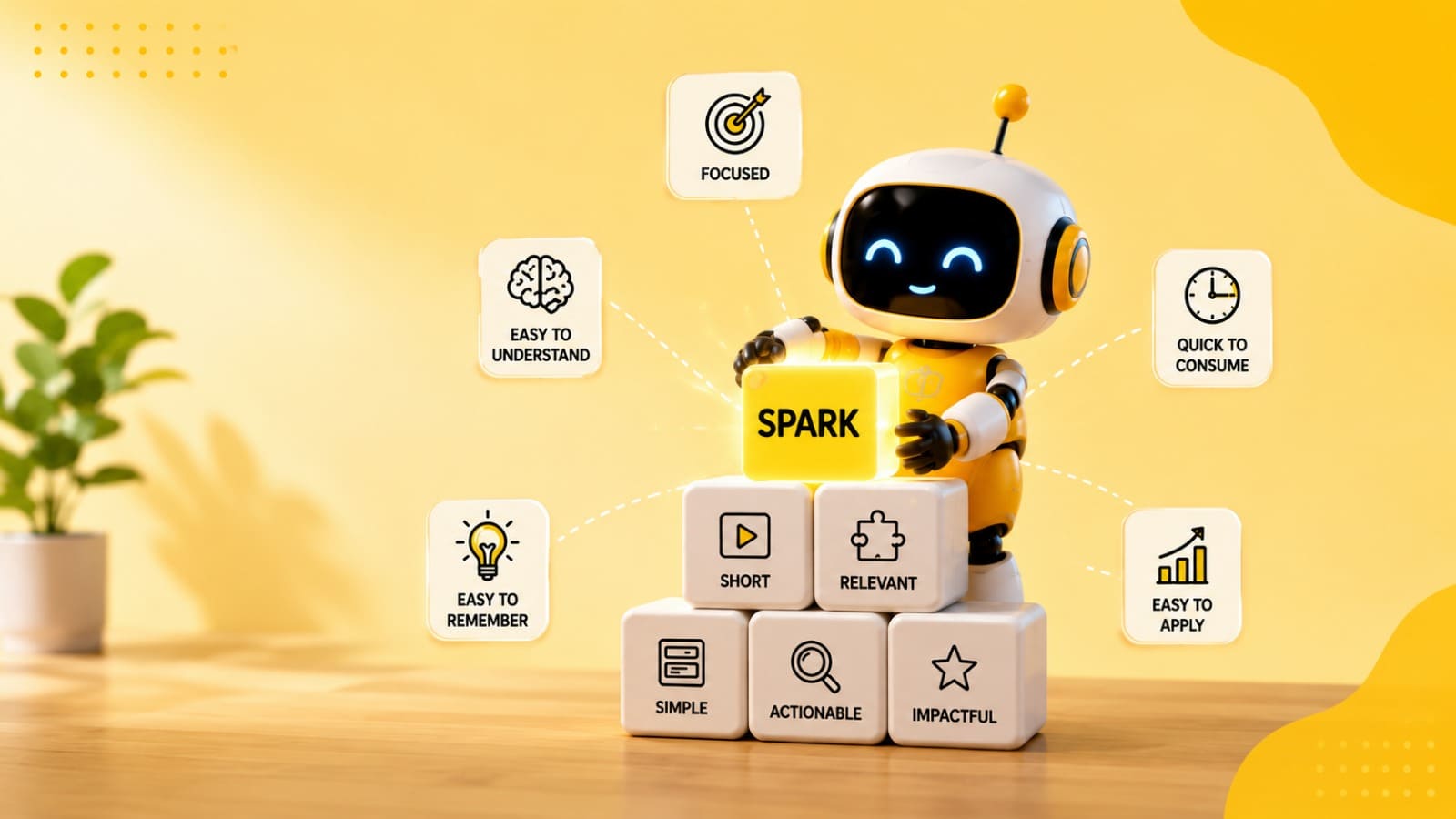
A SPARK is a focused learning experience designed to solve one micro-challenge at a time.
The metaphor is intentional.
A spark is tiny. Almost insignificant. But it can ignite a fire.
In the same way, a single learning moment can birth an insight, shift a mindset, and trigger transformation.
So what makes this design effective? A SPARK module is short, sharp, and practitioner-first. It follows a simple Why-What-How flow, respects learner’s attention, fits into busy schedules, and makes learning immediately usable. Instead of trying to “cover” everything, SPARK helps people learn what matters now.
Let us understand the 5 stages of the learning design that form the fitting acronym – SPARK:
S – Stimulate
Every SPARK begins with a problem, not a topic.
The best learning doesn't start by saying: "Today we will learn about customer centricity." It starts with: "Why do customers stop listening within the first minute of a sales conversation?"
The goal of this stage is to make the learner think - "That's exactly what I struggle with."
P – Purpose
Once attention is earned, relevance must follow. Purpose answers the learner's favourite question: "Why should I care?"
This section needs to clearly define the concept and the tangible payoff.
A – Application
This is where the concept needs to translate into repeatable behaviour.
The goal of this section is to demonstrate to the learner – “How do I actually do this.”
Not theory. Not philosophy. Just practical action.
R – Reflection
Insight happens when learners connect the learning to their own experiences. Reflection creates that moment. The goal is to make the learner pause and diagnose themselves.
K – Kickstart
Every SPARK must end with momentum. Not a project plan or a wish list. But a few simple action points that take less than five minutes to implement.
Transformation rarely starts with a giant leap. It starts with a small step.
The future of learning will not be defined by longer courses or larger content libraries.
It will be defined by our ability to solve real workplace challenges, one SPARK at a time.
If you are keen to gain the ‘SPARK’ advantage, get in touch with us on reachout@happcoach.com and we will be delighted to help.